
Sake Rice: Aiyama 愛山
The “diamond of sake rice”

This note was originally published inside the Vault of Raw, Grilled, Boiled a living knowledge garden of notes on Japanese sake and beyond. The original note lives there alongside entries on rice cultivars, yeasts, breweries, and brewing science. If you want the full cross-linked context, that’s the place to explore.
Summary
Aiyama is a sake rice cultivar bred in Hyogo in 1941, quietly cultivated in small volumes for decades before a surge in popularity that has it now ranking 13th in production volume. Difficult to grow and brew, but capable of a distinctive flavour profile when handled well, earning it the nickname “diamond of sake rice.”
Lineage
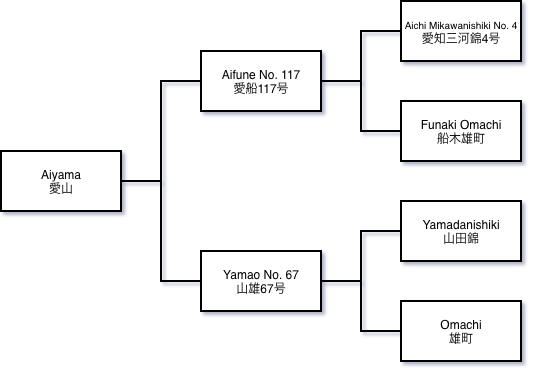
♀: Aifune No. 117 (愛船117号)
♂: Yamao No. 67 (山雄67号) A cross of Yamada Nishiki and Omachi
Prefecture: Hyogo 兵庫県
Crossing: 1941
Development: 1949 - 1951
Registration: Unregistered
Development name: 愛山11号
Rice type: Sake Rice
History
Aiyama is a strain that was crossed in 1941 at the Sake Rice Experimental Field at the Hyogo Prefectural Agricultural Experiment Station (兵庫県立農事試験場酒造米試験地). It has been around for many years and unlike other strains from its time that saw a heyday and now live in obscurity, Aiyama has managed to stand its own, albeit always modestly until the present times, where it has begun gaining more popularity. In essence, it was never widely cultivated or popular, thus it never fell out of favour as other cultivars such as Benkei 辨慶, Shin Yamadabo No. 1 新山田穂1号 or the Shiga Wataribune Lineage 滋賀渡船系統 did after the war.
Its official name is Aiyama No. 11. The name designation follows the naming convention of the time, that is, it combined the first kanji of each parent’s name. The name brand of rice ‘Aiyama’ has existed in Hyogo Prefecture since 1980. It is a long-established cultivar that has been cultivated since at least 1951.
At the start of cultivation in 1951, it is reported that the cultivated area was 31.4 hectares, and when the brand was established in 1980, the cultivated area was a relatively small 16 hectares. It increased slightly to 31 hectares in 1982 and remained at around 30 hectares for most of the time after that, jumping to 37 hectares from 1997 until 2004 according to the referenced data. Recent statistics focus on tonnage of rice produced rather than hectares, so it is difficult to find a comparison with more recent numbers.
The production in 2021 was 767t and in 2022 890t, which is a clear indicator of an increased popularity, now ranking 13th in terms of volume. All this indicates that Aiyama, rather than having fallen out of use after the war, is having its golden age at the current time, as it has always been produced in small and stable amounts.
> Based on rough calculations, the following estimates apply, assuming that sake rice production yields about 4.5 to 5 tonnes per hectare, and knowing that Aiyama is a complex rice to grow and that sake brewing specific rice tends to be more towards the bottom end of the spectrum, if we assume 4 to 4.5 tonnes per hectare, we would need anywhere between 180 to 200 hectares to produce the production numbers reported above for 2021 and 2022. That is brown rice, not accounting for sorting, husking, and milling.
Prior to 1995, it is said that only a single brewery used it, namely Kenbishi Shuzo 剣菱酒造, or at most a handful, with Kenbishi purchasing the majority of the production. The claim that only Kenbishi was using it is not sustained as it is a strain controlled by a public body so how did they get the monopoly or managed to contract farmers to cultivated Aiyama remains unclear. This account appears in several sources, though it is likely not the whole picture.
During the Great Hanshin-Awaji Earthquake of 1995, Kenbishi Shuzo was affected by the disaster and was unable to purchase its contracted supply of Aiyama sake rice, of which it had been the sole user. It is said that Takagi Shuzo 高木酒造], makers of the famous Juyondai 十四代 brand, stepped in to purchase it instead. On top of this it has been claimed to be of superior quality to Yamadanishiki from the mid Heisei Period 平成 (1989 - 2019) which has bolstered its popularity over time and aligns temporally with the account above. Since then, the number of breweries using Aiyama has surged, and various breweries began releasing sake made from this cultivar.
Whether or not the earthquake story is accurate, Aiyama is clearly benefiting from widespread popularity. While Omachi 雄町 commands a larger following, Aiyama has its devoted fans too, myself included. In some blogs and media they even refer to Aiyama as the “diamond of sake rice”.
Characteristics
Aiyama is a late-ripening cultivar with a similar timing to Yamadanishiki. Its stalk height is comparable at about 94cm. Although its grains are larger than Yamadanishiki’s, it was considered less prone to lodging by the standards of the time; compared to modern cultivars, however, it is more prone to lodging. Aiyama is an intermediate-type plant, with a high yield potential, mostly due to the heavy weight of its grains at 30g per 1000 grain measure compared to the 28g benchmark of Yamadanishiki.
The quality of the grain is considered somewhat inferior as it is prone to breaking at high-polish rates due to its large shinpaku 心白. This is compounded by a slight tendency toward harashiro (腹白), a displacement of the shinpaku toward one side of the grain. Its stalk is medium in both rigidity and thickness, and the ears are whitish in colour.
It also presents challenges in both cultivation and threshing, making it a difficult cultivar to work with. This difficulty has kept production volumes relatively low.
On top of the aforementioned characteristics, it is said to be susceptible to developing off-flavours. However, if brewed skilfully, it produces a unique flavour. Perhaps this is why it has begun to spread among other breweries.
References
池上 勝. 酒米試験地の設立と初期品種系統「兵庫雄町」,「山雄67号」および「愛山」の育成経過. 兵庫県立農林水産技術総合センター研究報告. 農業編 = Bulletin of the Hyogo Prefectural Technology Center for Agriculture, Forestry and Fisheries. Agriculture section. (54) 2006.3,p.33~41. https://ndlsearch.ndl.go.jp/books/R000000004-I8601918
副島顕子. 酒米ハンドブック(改訂版). 文一総合出版, 2017.
米穀データバンク. _米品種大全7_. 米穀データバンク, 2023.
https://note.com/riquat_sake/n/n6c7326a70d79
https://komekko.blogspot.com/2020/11/11.html